Modern businesses are overwhelmed by repetitive tasks, disconnected tools, and manual processes that drain productivity. From handling customer inquiries to updating CRM records and managing internal workflows, most organizations still rely on processes that could — and should — be automated. AI workflows are changing this reality, and for businesses across Africa, GCC, and MENA, they represent a direct path to operational modernization without large infrastructure investments.
In this article
- What AI workflows actually are
- Why businesses are adopting them at scale
- Real-world use cases across business functions
- Platforms and tools that power AI workflows
- How to design effective AI workflows
- Why AI workflows are becoming business infrastructure
What Are AI Workflows?
AI workflows are automated sequences of tasks that integrate artificial intelligence to process information, make decisions, or assist human teams — without requiring manual intervention at every step.
Traditional automation follows rigid, predefined rules. AI workflows go further — they can analyze content, generate responses, classify information, and trigger contextual actions based on what they find. The difference is intelligence, not just speed.
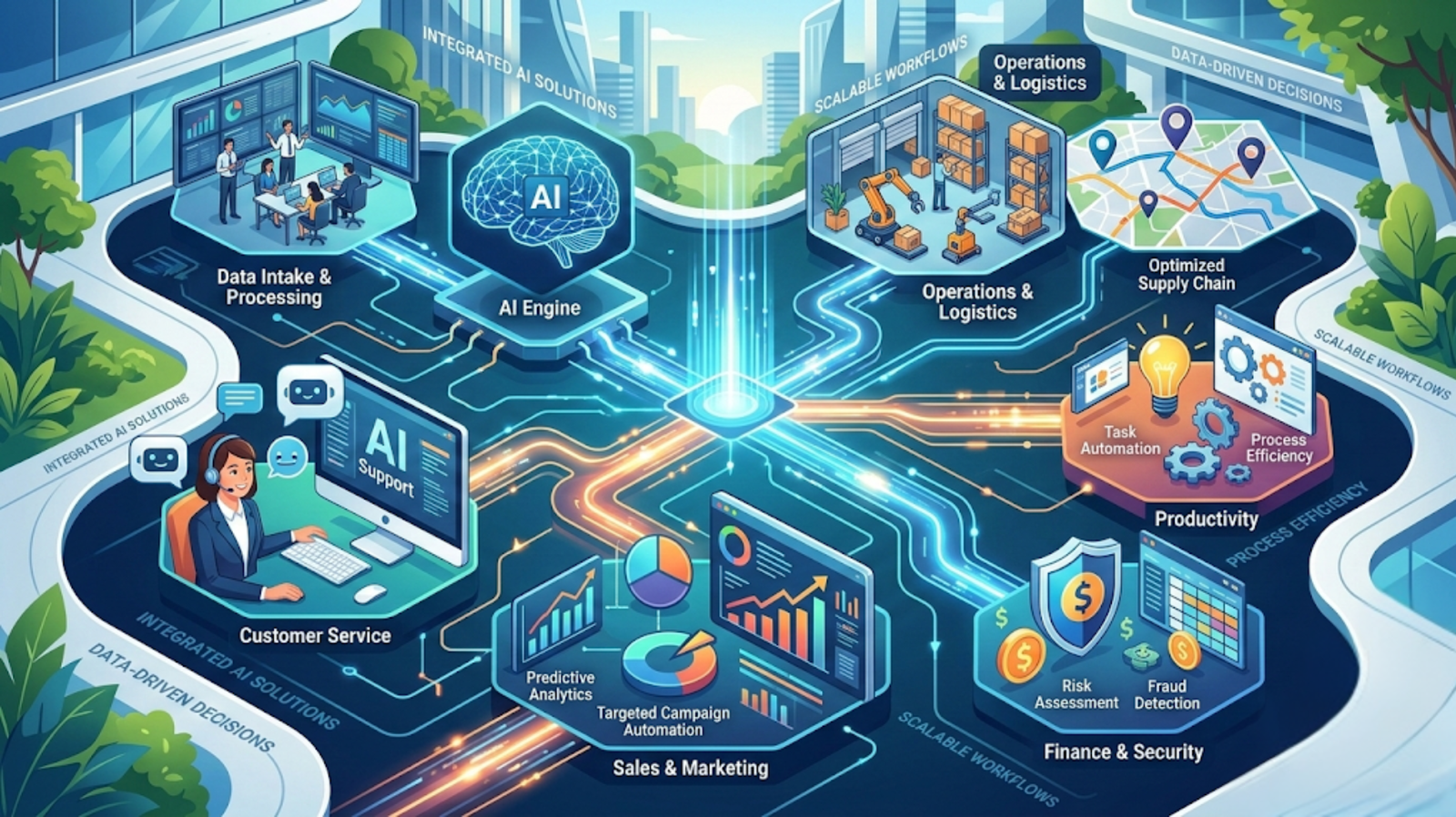
A typical AI workflow looks like this
- Capture data from a form, email, CRM, or external trigger
- Send that information to an AI model for analysis or processing
- Generate a summary, draft response, classification, or decision
- Update connected systems automatically based on the output
- Notify a human team member only when their input is genuinely required
Why Businesses Are Adopting AI Workflows
Organizations today operate across a sprawl of digital platforms — email, CRM, messaging tools, databases, and project management software. Without automation, employees spend enormous amounts of time moving information between these systems manually. AI workflows solve this by connecting tools together and letting intelligence handle the flow.
Reduced Manual Work
Data entry, reporting, and document tasks handled automatically
Faster Response Times
AI generates replies to inquiries and tickets instantly
Consistent Data
Systems stay synchronized — human errors eliminated
Scalable Operations
Grow without adding operational complexity or headcount
AI workflows are not about replacing people. They’re about removing the repetitive work that prevents teams from focusing on meaningful, high-impact tasks.
Tarek Yassine, CEO — Inboxive SolutionsReal-World Use Cases Across Business Functions
AI workflows can be applied across virtually every operational area. These aren’t experimental projects — they’re live, working systems running inside modern businesses today.
Customer Support
Analyze incoming messages, categorize requests, suggest responses, and escalate to humans only when needed
Lead Qualification
Evaluate new leads automatically, enrich contact data, and route opportunities to the right sales rep
Content Processing
Summarize, categorize, or extract insights from documents, emails, and forms automatically
Internal Notifications
Alert teams when deal updates, operational triggers, or customer activity thresholds are hit
CRM Data Management
Clean, enrich, and maintain CRM records continuously — so data stays accurate and actionable
Automated Reporting
Generate and distribute operational reports on schedule, without any manual compilation
Platforms That Power AI Workflows
Modern automation platforms make it possible to design sophisticated AI workflows without building complex software from scratch. Tools like n8n allow businesses to connect applications, define intelligent triggers, and create automated actions across their entire technology stack.
CRM Platforms
HubSpot, Salesforce — synced and enriched automatically
Communication Tools
Gmail, Slack, WhatsApp — connected into unified workflows
Cloud Applications
Google Workspace, databases, and APIs integrated seamlessly
AI Models
Anthropic Claude, OpenAI — embedded at the right moments in every flow
The result is a connected digital environment where systems communicate automatically — and your team spends their time on decisions, not data movement.
Designing Effective AI Workflows
Successful AI workflow implementation requires careful planning. The biggest mistake organizations make is trying to automate everything at once. Start by identifying where time is being lost — then build from there with clear structure.
-
1
Process Mapping
Understand exactly how information moves through the organization before touching any automation tool
-
2
Automation Opportunity Identification
Find the tasks that consume the most time, repeat most frequently, and carry the lowest decision complexity
-
3
AI Integration Design
Determine exactly where artificial intelligence adds value — classification, generation, routing — and where simple logic is enough
-
4
Monitoring & Continuous Optimization
Review workflow performance regularly and refine automation logic as business processes evolve
AI Workflows Are Becoming Business Infrastructure
As organizations scale, manual processes become the bottleneck that limits growth. AI workflows are quickly shifting from optional improvements to core operational infrastructure — as foundational as a CRM or ERP system.
Faster Decision-Making
AI surfaces the right information at the right moment — teams act faster with more confidence
Improved Accuracy
Automated flows eliminate the human error that accumulates across manual processes
Operational Efficiency
Teams accomplish more with the same resources — without burning out on repetitive work
Scale Without Friction
Grow operations without a proportional increase in complexity or headcount
Organizations that embrace workflow automation today are building an operational advantage that compounds over time. Those that don’t will find themselves managing the same bottlenecks at a larger, more expensive scale.
Let your systems handle the repetitive work.
We design intelligent automation workflows using n8n and AI — connecting your tools, eliminating manual tasks, and building systems that scale with your business across GCC and Africa.
Explore AI Workflow Services →